


How to Mitigate GNSS / Wireless Interference from USB 3.2 Cables
The Problem: USB 3.2 Leaks RF Noise
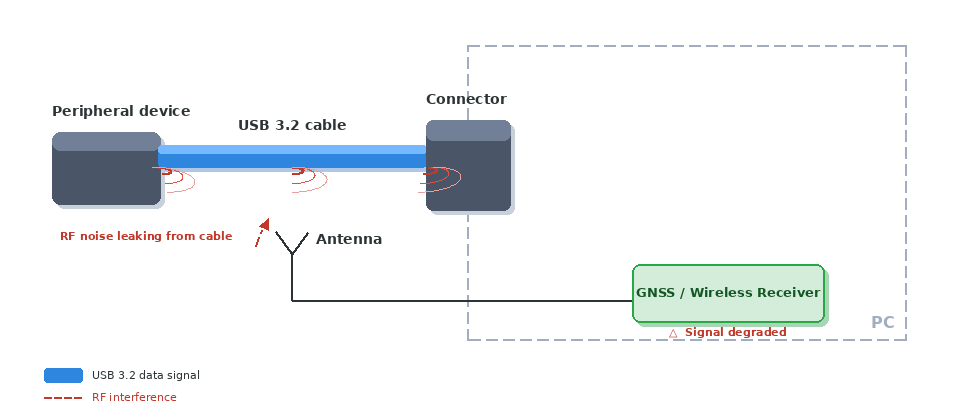
USB 3.2 (5Gbps) is widely used for high-performance cameras and sensors, but it can introduce RF interference with GNSS, Wi-Fi, and Bluetooth systems—especially in compact system designs.
This issue has been studied in "USB 3.0 Radio Frequency Interference Impact on 2.4 GHz Wireless Devices" by Intel®, which shows that USB 3.x signaling generates broadband noise across a wide frequency spectrum. While the paper focuses on 2.4 GHz interference, the same principle applies to GNSS.
In practice, USB 3.2 transmissions can overlap with GNSS frequency bands such as L1 (1.575 GHz) and L2 (1.225 GHz), making interference a real system-level concern.
Why It Matters
In space constraint applications such as drones, robotics, and autonomous fleets, USB3 Vision cameras and GNSS antennas are often placed very close together. This can result in:
- GNSS signal degradation or reduced accuracy
- Unstable wireless connectivity (Wi-Fi and Bluetooth dropouts)
- Overall system reliability issues
Practical Mitigation Strategies
1. Increase Physical Separation
The most effective approach is to maximize the distance between USB cables and RF antennas. However, in compact systems, this is often not feasible.
2. Improve Cable Shielding
When separation is limited, cable shielding becomes the key mitigation method. A well-shielded cable contains RF noise at the source before it can radiate outward and interfere with nearby antennas.
USB Shielding Standards — and Their Limitations
The USB Implementers Forum (USB-IF) defines baseline shielding requirements for EMC compliance. However, real-world effectiveness varies significantly across cable types.
- Many consumer-grade cables—especially low-cost options—do not fully meet shielding expectations despite carrying compliant labeling.
- The right-angle connectors are the typical weak point because the internal shielding is often inproperly handled to fit compact overmolds, increasing EMI leakage at the connector joint.
- USB 3.x was designed for consumer applications, not RF-sensitive environments. Standard compliance levels are insufficient when GNSS and wireless systems operate in close proximity to high-speed USB signals.
Because USB 3.2 noise spans such a broad frequency range, it cannot be effectively filtered at the antenna level. The most effective approach is to reduce emissions at the source — the cable and its connectors.
Measured Impact of Shielding
The table below shows measured shielding effectiveness in the GPS frequency band across three cable types:
| Cable Type | Shielding Effectiveness (GPS Band) |
|---|---|
| Regular USB 3.2 Cable | -52 dB |
| USB-IF Compliant USB 3.2 Cable | -60 dB |
| Newnex Enhanced Shielding USB 3.2 Cable | -68 dB |
Result: The Newnex Enhanced Shielding USB 3.2 Cable provides up to a 30% reduction in GPS band interference compared to a regular off-shelf USB 3.2 cable.
Why Enhanced Shielding Is the Right Solution
Newnex enhanced shielding cables are purpose-built for space-constrained, RF-sensitive environments where standard cables fall short. Key design features include:
- Double-shielded cable construction — two layers of shielding contain broadband RF noise across the full cable length.
- Reinforced connector shielding — connectors and overmolds are reinforced to eliminate common EMI leakage points.
- Significantly reduced EMI leakage — emissions are suppressed at the source, where antenna-level filtering cannot reach.
Summary
USB 3.2 interference is an inherent challenge in high-speed, compact systems. When physical separation is limited, enhanced shielding is the most practical and effective solution to protect GNSS and wireless performance. Standard USB-IF compliant cables are often insufficient in RF-sensitive environments—purpose-built, double-shielded cables address the problem at the source and can reduce GPS band interference by up to 30%.


Intel Corporation, "USB 3.0 Radio Frequency Interference Impact on 2.4 GHz Wireless Devices"
https://www.usb.org/sites/default/files/327216.pdf